Types of Warehouse Robots: The 2026 Guide to Logistics Automation
The global supply chain is under unprecedented pressure. Faced with escalating labor costs and the relentless demand for faster order fulfillment, relying purely on manual labor and traditional forklifts is no longer sustainable.
To remain competitive, an increasing number of companies are turning to warehouse robotics. The question for supply chain leaders is no longer if they should automate, but which types of robots are best suited for their specific operational needs. This guide will explore the main categories of warehouse robotics available today and how they are transforming the logistics landscape.
What is Warehouse Robotics?
Warehouse robotics involves intelligent machines engineered to automate the physical movement of inventory. Whether working autonomously or alongside human staff, their primary goal is to accelerate facility throughput while maintaining strict safety standards.
The widespread adoption of these technologies is driven by a simple business reality: modern supply chains must simultaneously slash operating expenses, scale productivity, and deliver flawless customer experiences.
From inbound receiving and high-density storage to order picking and outbound staging, robots are now integral to the entire fulfillment lifecycle. Their ultimate advantage is undeniable: they provide relentless, error-free operation 24 hours a day, easily outperforming the limitations of traditional manual handling.
The 6 Main Types of Warehouse Robots
When evaluating automation for your facility, it helps to understand the distinct categories of warehouse robots and the specific tasks they are engineered to solve.
1. Autonomous Mobile Robots (AMRs)
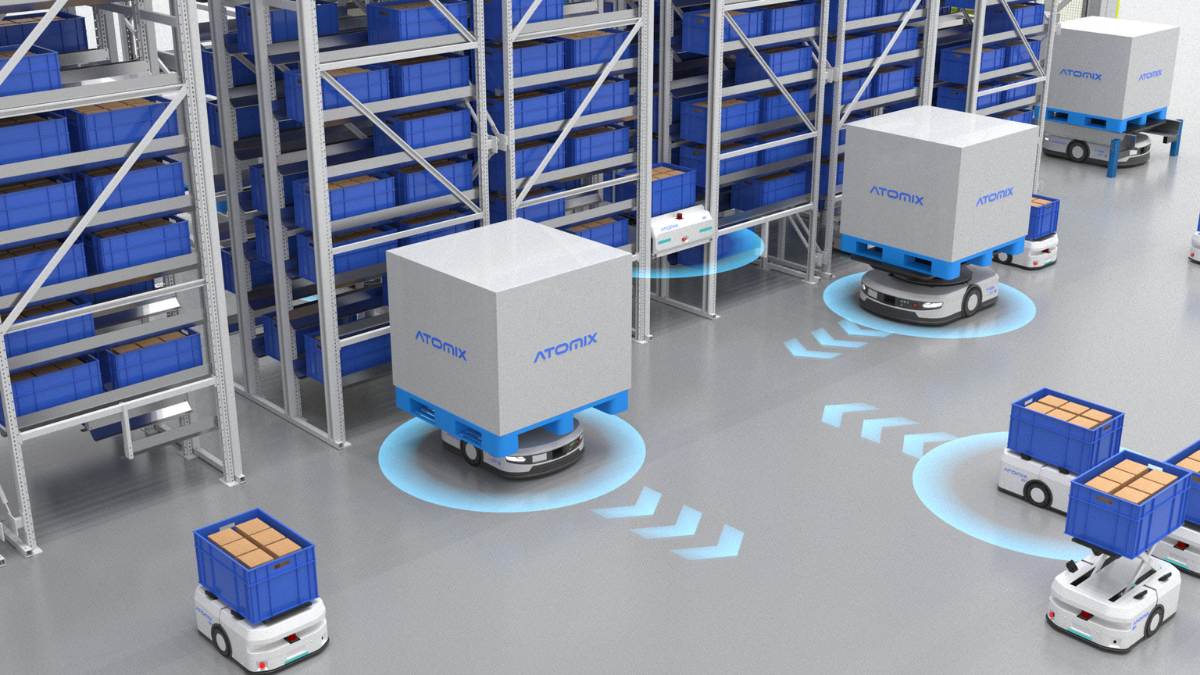
Autonomous Mobile Robots (AMRs) are the most flexible and rapidly growing segment of warehouse robotics. Unlike older technologies, AMRs do not require fixed tracks, wires, or extensive facility modifications to operate. Instead, they use LiDAR, cameras, and AI (often SLAM technology) to dynamically map the warehouse and navigate freely around obstacles and humans.
- Best Use Case: Transporting cases, totes, or heavy pallets across the warehouse floor; facilitating highly efficient Goods-to-Person (GTP) picking strategies by bringing inventory directly to stationary workers.
2. Automated Storage and Retrieval Systems (AS/RS)
Automated Storage and Retrieval Systems (AS/RS) are large-scale, high-density automated systems designed to store and retrieve goods from towering racks. While older versions relied on bulky stacker cranes, modern AS/RS heavily utilize intelligent shuttle systems. These shuttles dive deep into grid architectures, retrieving pallets or bins with pinpoint accuracy.
- Best Use Case: Maximizing vertical cubic space, high-density storage (like cold chain environments), and managing heavy pallet workflows without requiring wide forklift aisles.
3. Automated Guided Vehicles (AGVs)
AGVs are the predecessors to AMRs. They are automated vehicles (like robotic forklifts or tuggers) that transport heavy materials. However, their navigation is highly rigid. AGVs must follow fixed physical paths embedded in the floor, such as magnetic tape, wires, or QR codes. If an obstacle blocks their path, they stop and wait rather than rerouting.
- Best Use Case: Simple, repetitive, point-A-to-point-B transportation of heavy pallets in highly structured, unchanging environments.
4. Articulated Robotic Arms (Pick-and-Place Robots)
These stationary robots feature multi-jointed arms equipped with advanced vision systems and versatile grippers (such as suction cups or mechanical claws). They mimic human dexterity but operate with tireless speed and precision.
- Best Use Case: End-of-line palletizing and depalletizing, high-speed sorting, and automated piece-picking at packing stations.
5. Collaborative Robots (Cobots)
Cobots are designed specifically to work safely alongside human operators in a shared workspace. They are equipped with force-limiting sensors; if they bump into a human, they immediately stop.
- Best Use Case: Assisting warehouse staff with heavy lifting, repetitive packaging tasks, or guiding workers through picking routes.
6. Automated Sortation Systems
These systems combine high-speed conveyor technology with robotic diverters or individual sorting bots. They rapidly identify, categorize, and route products to their correct outbound destination based on barcodes or RFID tags.
- Best Use Case: High-volume parcel routing, cross-docking, and organizing outbound shipments by carrier or zip code.
AMR vs. AGV: What is the Key Difference?
Because they both move goods across the floor, AMRs and AGVs are often confused. The core difference lies in their intelligence and navigation.
- AGVs (Automated Guided Vehicles): Think of them like trains. They follow a strict track (magnetic tape/wires). They are inflexible; changing their route requires physical warehouse modifications.
- AMRs (Autonomous Mobile Robots): Think of them like self-driving cars. They use AI and sensors to understand their environment. If a pallet is dropped in an aisle, an AMR will intelligently calculate a new route around the obstacle to reach its destination.
What Are the Top Benefits of Warehouse Robots?
Deploying the right mix of robotics provides significant, measurable returns for your business operations:
- Maximizing Warehouse Space: Systems like AS/RS allow you to build upwards and eliminate wide aisles, drastically increasing your storage capacity within your existing footprint.
- Optimizing Labor Structure & Efficiency: By taking over grueling and repetitive tasks, robots reduce reliance on pure physical labor, mitigating the impact of rising labor costs and high turnover rates.
- Improving Accuracy and Speed: By eliminating manual data entry and human picking errors, robotics ensure the right product reaches the right customer every time.
- Enhancing Workplace Safety: Automating heavy material handling directly reduces the risk of forklift accidents and repetitive strain injuries among your staff.
Comprehensive Warehouse Automation Solutions by Atomix Robotics
Enterprise-grade smart warehouses often require a cohesive integration of diverse automated systems. We provide a comprehensive and flexible approach to warehouse automation by combining standardized heterogeneous robots with intelligent software orchestration, tailoring solutions to meet specific operational needs.
Modular Hardware Architecture: The “Mix” Subsystems
Atomix offers highly adaptable, modular subsystems designed to optimize specific operational zones within a facility:
- Storage Mix: Utilizing industrial-grade Pallet Shuttles and Bin Shuttles, we deliver an AS/RS solution that integrates deeply into your racking infrastructure, achieving high space utilization.
- Handling Mix: To connect high-bay storage to the rest of the facility, our fleet of AMRs safely and efficiently transports pallets and bins across the warehouse floor with autonomous precision.
Intelligent System Orchestration: The Atomixer Software Platform
Coordinating a heterogeneous fleet of robots demands robust system orchestration. The Atomixer Software Platform serves as the central control system. By seamlessly integrating our iWMS, WES, and TES modules, Atomixer utilizes over 50 advanced algorithms to schedule shuttles and dynamically route AMRs, ensuring your automated facility operates as a unified and efficient ecosystem.
Ready to optimize your current supply chain? Contact us today to get a customized warehouse automation solution.