What is a Smart Warehouse? 2026 Guide to Logistics Automation
The logistics landscape is fundamentally changing. Supply chains are more complex, consumer expectations for next-day delivery are relentless, and warehouse labor shortages continue to disrupt operations. In this high-pressure environment, relying on paper checklists, manual data entry, and traditional forklifts is a guaranteed way to fall behind.
According to recent market analysis by Fortune Business Insights, the global smart warehousing market size is experiencing explosive growth, projected to reach nearly USD 99.71 billion by 2034. This massive global investment indicates one undeniable fact: the future of supply chain fulfillment relies entirely on interconnected automation.
If you are looking to modernize your operations, the first question to ask is: what is a smart warehouse, and how does it actually work?
What is a Smart Warehouse?
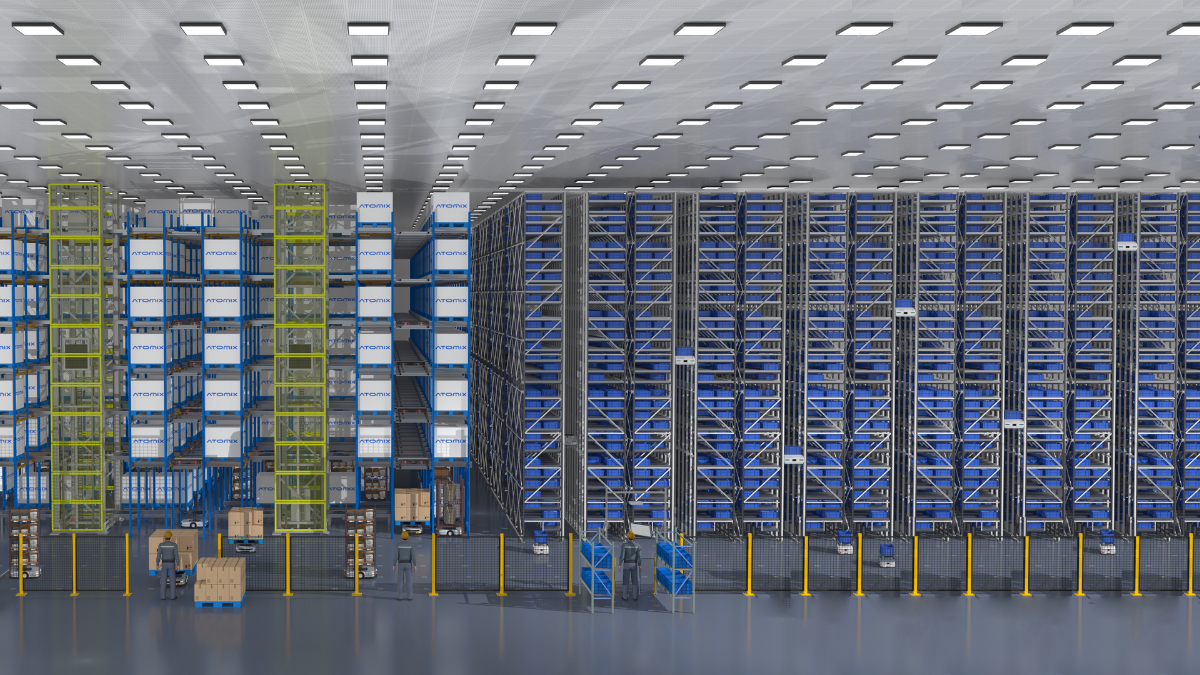
A smart warehouse is an intelligent fulfillment ecosystem where interconnected technologies work together to receive, store, pick, and ship goods with minimal manual labor.
Unlike traditional facilities that rely heavily on human decision-making, a smart warehouse “sees, thinks, and acts” autonomously. By integrating advanced software (the brain) with robotics (the muscle) and IoT sensors (the nervous system), a smart warehouse digitizes the entire floor. It dynamically routes robots to prevent traffic jams, continuously monitors inventory in real-time, and predicts demand bottlenecks before they happen.
Smart Warehouse vs. Traditional Warehouse: What’s the Difference?
To truly understand what a smart warehouse is, it helps to compare it directly to traditional logistics operations:
Data and Visibility: Traditional warehouses operate in silos; data is often updated manually after a task is completed, leading to blind spots. A smart warehouse offers 100% real-time visibility, tracking every pallet and bin automatically using sensors and software.
Labor and Movement: In a traditional setting, humans walk miles every day pushing carts or driving forklifts to find inventory. In a smart warehouse, automated robots execute the heavy lifting and utilize “Goods-to-Person” systems, bringing the exact items directly to stationary human workers.
Space Utilization: Traditional warehouses require wide, empty aisles for forklift maneuverability. Smart warehouses utilize automated high-density storage grids, packing goods tightly together and eliminating wasted vertical and horizontal space.
Decision Making: Traditional facilities are reactive, solving problems as they occur. Smart warehouses are predictive, using Artificial Intelligence (AI) to forecast demand, optimize storage slotting overnight, and proactively plan picking routes.
Core Technologies of a Smart Warehousing System
You cannot just buy a single machine and call your facility “smart.” What makes a warehouse smart is the seamless convergence of several foundational technologies:
1. Warehouse Management Systems (WMS)
The WMS is the central brain of the smart warehouse. It ingests massive amounts of data to coordinate all operations. It tracks inventory down to the specific lot number, handles complex order logic, and issues direct commands to both human workers and physical machinery.
2. Internet of Things (IoT) & RFID
IoT sensors and Radio Frequency Identification (RFID) tags act as the facility’s senses. They replace manual barcode scanning by providing real-time location tracking for assets. They also monitor environmental factors, ensuring temperature-sensitive goods (like pharmaceuticals or cold-chain foods) remain within strict safety parameters.
3. Artificial Intelligence (AI) and Machine Learning
AI moves warehouse operations from reactive to predictive. Machine learning algorithms analyze historical data to forecast future demand flawlessly. AI enables dynamic slotting—automatically instructing robots to move the fastest-selling goods closer to the packing stations so they are ready for the morning shift.
4. Robotics and Automation (AS/RS)
This is where digital intelligence meets the concrete floor. Automated Storage and Retrieval Systems (AS/RS), Autonomous Mobile Robots (AMRs), and high-density pallet shuttles execute the physical heavy lifting. They transport pallets and dive deep into racking systems to retrieve goods with pinpoint accuracy and zero fatigue.
What Are the Top Benefits of a Smart Warehouse for Your Business?
Transitioning to a smart warehouse represents a significant strategic shift for any logistics operation. Implementing an interconnected, automated system directly impacts a business’s bottom line in several measurable ways:
Decreases order fulfillment and storage costs
A major component of warehouse management is controlling the time and resources that go into daily operations. When added up, traditional fulfillment costs include:
Real estate rent and holding costs
Labor wages and overtime pay
Equipment maintenance and energy consumption
Reverse logistics from mis-shipments
Integrating smart warehousing helps condense your storage footprint (minimizing empty space) and streamline the fulfillment cycle. By upgrading to solutions like Atomix’s high-density automated storage systems, businesses can effectively lower their cost-per-order and reallocate capital toward core growth initiatives.
Minimizes picking and shipping errors
Manual picking naturally introduces a margin of human error, which can accumulate costs over time. These mistakes often lead to:
Return logistics: Paying for return shipping and restocking processes.
Material waste: Replacing damaged packaging and managing lost product value.
Customer dissatisfaction: Resolving complaints and managing potential churn.
Automated systems maintain consistent accuracy over long shifts. Utilizing platforms like the Atomixer Software Suite as your intelligent WMS standardizes inventory movements, significantly improving order precision and reducing return rates.
Optimizes labor utilization and workplace safety
Finding and retaining reliable warehouse labor remains an industry-wide challenge. Furthermore, traditional warehouse environments carry inherent occupational risks:
Physical strain: Manual material handling can lead to repetitive motion injuries.
Equipment incidents: Human-driven machinery in mixed-traffic aisles is a common cause of workplace claims.
Automation helps reduce the physical toll on warehouse teams. By deploying Atomix’s Autonomous Mobile Robots (AMRs) and a goods-to-person picking strategy, companies can transition workers away from heavy material transport and into safer, supervisory roles.
Enhances scalability during peak demand
During seasonal holidays or promotional events, traditional warehouses often need to hire and train temporary workforces, which can disrupt standard operations. A smart warehouse provides operational elasticity to manage:
E-commerce volume spikes (like Black Friday).
Seasonal inventory changeovers.
Fluctuating supply chain deliveries.
When fulfillment volumes shift, Atomix’s flexible robotic fleets offer the modularity needed to adjust throughput. This helps maintain consistent delivery schedules without constantly relying on emergency labor sourcing.
Atomix Robotics’ Tech-Enabled Smart Warehousing Solutions
Atomix Robotics is a global provider of intelligent warehouse automation, equipping forward-thinking logistics centers with best-in-class technology to create modern, end-to-end supply chain solutions.
By automating critical warehousing tasks—such as high-density storage, goods-to-person picking, inventory management, and outbound shipping—Atomix helps you improve fulfillment speed, optimize operational costs, and provide consistent value to your customers.
To get a glimpse inside how our smart warehouse operations actually work, check out our technology in action below:
The Atomixer Software Platform: Your Ultimate Digital Brain
A smart warehouse is only as intelligent as the software running it. The Atomixer Software Platform serves as your comprehensive digital operating system. Seamlessly integrating three core modules—iWMS (Warehouse Management), WES (Warehouse Execution), and TES (Task Execution)—it acts as the central brain of your facility. It processes complex order logic, orchestrates traffic to prevent AMR collisions, and synchronizes your entire fleet of containers and robots in real-time.
Flexible Hardware: Pallet Shuttles and AMRs
Atomix pairs this powerful software with highly adaptable physical automation. Our Four-Way Pallet Shuttles navigate complex deep-lane grid layouts to deliver ultra-high-density storage, utilizing your vertical space efficiently. Once the goods are brought down, our fleet of Autonomous Mobile Robots (AMRs) takes over, safely transporting pallets across the floor directly to the shipping docks.
Together, Atomix hardware and software create a unified, highly adaptable smart warehouse that scales alongside your business.