How Do Autonomous Mobile Robots (AMRs) Work?
The global logistics landscape is undergoing a monumental shift. Faced with acute labor shortages, surging e-commerce demands, and the need for higher operational agility, facilities worldwide are replacing rigid, traditional material handling systems with flexible automation.
At the forefront of this revolution are Autonomous Mobile Robots (AMRs). Unlike legacy transport systems, AMRs operate without fixed tracks or physical wires, navigating complex warehouse floors with remarkable independence. But how exactly do these intelligent machines think, see, and make split-second decisions?
This guide breaks down the core technologies behind AMRs, how they navigate, where they deliver the highest ROI, and how modern enterprises deploy them at scale.
How Do AMRs See and Sense Their Environment?
To navigate an unpredictable warehouse floor safely, an AMR requires a multi-layered sensory architecture—acting as its eyes, ears, and spatial orientation system.
Modern AMRs utilize Multi-Sensor Fusion. By merging data from diverse sensors in real time, the robot creates a complete, dynamic understanding of its surrounding space.
Sensor Type | Primary Function | Key Strengths | Best Used For |
LiDAR | Distance measurement & mapping | High precision, unaffected by ambient light changes | Spatial mapping, localization, dynamic obstacle avoidance |
3D Cameras | Visual sensing & object identification | Captures rich visual data, height differences, and shapes | Pallet pocket detection, boundary checking, object classification |
IMU & Encoders | Real-time motion & orientation feedback | Fast response, fills in brief sensor gaps | Motion control, path correction, pose estimation |
Safety Sensors | Close-range obstacle detection | Immediate response, robust emergency backup | Emergency stopping, close-proximity safety bumpers |
How Do AMRs Build Maps and Know Where They Are?
Traditional transport systems rely on fixed magnetic tape or embedded wires. In contrast, modern AMRs use flexible mapping technology to move around your facility without changing your floor infrastructure.
Navigation Method Comparison
Depending on your facility layout, AMRs can leverage different navigation strategies:
Navigation Method | Sensor Core | Primary Advantage | Best Operational Scenario |
Laser SLAM | LiDAR | High flexibility, zero physical floor modifications | Dynamic warehouse floors, evolving layout changes |
Marker Navigation | QR Code / Visual Markers | High speed, millimeter-level repeatability | High-density traffic aisles, structured picking grids |
Hybrid Fusion | LiDAR + Vision + IMU | Maximum adaptability across varied environments | Complex industrial facilities with changing lighting and obstacles |
Precise Positioning
Once a map is built, the AMR continuously compares what its sensors see against that map to determine its precise coordinates. Modern AMRs achieve millimeter-level positioning and stopping accuracy, ensuring they align smoothly with racks, conveyors, or machinery every single time.
How Do AMRs Plan Routes and Avoid Unexpected Obstacles?
Unlike a fixed conveyor that halts the entire line when blocked, an AMR actively solves traffic challenges on the fly.
When assigned a task, the AMR’s navigation system calculates the most efficient route across the facility. It treats the warehouse floor as a living map, constantly balancing travel distance against safety and traffic flow.
If a person, forklift, or dropped box blocks its intended path, the AMR doesn’t freeze or wait for manual assistance. It senses the obstacle instantly, calculates a smooth detour in milliseconds, and continues toward its destination without missing a beat.
How Do Dozens of AMRs Work Together Without Crashing?
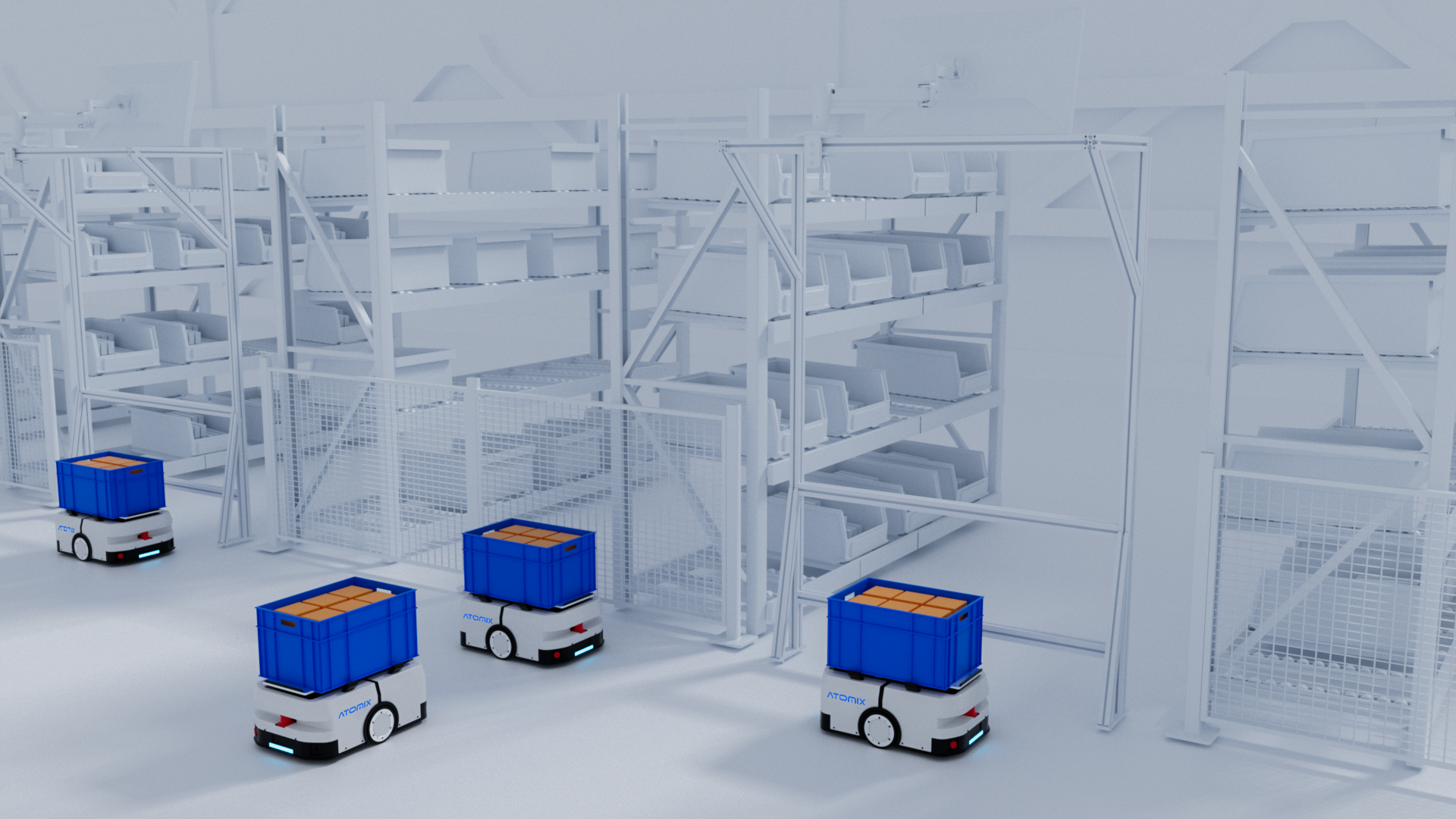
A single AMR is an impressive tool; a fleet of dozens of AMRs operating in the same facility is an orchestration challenge. This is where the Atomixer Software Platform acts as the master brain. It manages the real-time “traffic rules” for the entire facility, ensuring:
- Intersection Priority: Manages busy intersections dynamically to prevent bottlenecks and gridlock.
- Dynamic Task Allocation: Assigns jobs to the optimal robot based on proximity, load requirements, and battery levels.
- Fleet Collaboration: Coordinates different classes of robots (such as heavy pallet movers and light tote lifters) into one unified workflow.
What Industries Are AMRs Best Suited For?
AMRs thrive in dynamic environments requiring flexible material movement, rapid scalability, and seamless integration with existing warehouse systems.
Real-World Industry Success Stories
- E-Commerce Speed: In partnership with e-commerce leader Lotte, Atomix deployed an intelligent AMR fleet. The solution accelerated internal transport, effortlessly absorbing massive order spikes during peak shopping seasons.
- Heavy Parts Handling: Auto parts leader VAZLO required high-density storage and precise movement for heavy goods. Atomix combined heavy-duty systems and AMRs through our Handling Mix to automate pallet handling, supporting payloads over 1,500 kg while maximizing storage density.
- Manufacturing Sync: Manufacturing titan Tramontina integrated its production lines directly with automated storage. The system smoothly bridges manufacturing output with warehouse storage, maintaining constant, uninterrupted throughput.
Frequently Asked Questions (FAQ)
1. Do AMRs require constant internet connectivity to navigate?
No. All core navigation, sensing, mapping, and dynamic obstacle avoidance happen locally on the robot. Network connectivity is only used to receive new task assignments from the central software.
2. Are AMRs safe to operate alongside human workers?
Yes. AMRs are built with multi-layered safety systems, including laser scanning and physical bumpers, ensuring they stop immediately if someone steps into their path.
3. How fast can an AMR travel safely?
Travel speeds are adjustable based on operating conditions and safety requirements, with modern AMRs capable of reaching speeds of 2 m/s or higher in clear aisles while smoothly modulating speed in tighter spaces.
4. How long does deployment take compared to traditional automation?
Because AMRs do not require floor magnets, wires, or structural facility changes, mapping and deployment can often be completed in a fraction of the time required for legacy automated systems.