Euro Pallet vs. US (Standard) Pallet: What Are the Differences?
In global supply chain management, the humble wooden pallet is the unsung hero. It is the standardized unit that allows goods to move seamlessly from a manufacturing plant to a cargo ship, and finally to a distribution center.
The Global ISO Pallet Standards
However, “standardized” does not mean universal. When we talk about mainstream global logistics, the two most dominant and widely used formats you will encounter are the Standard US Pallet (48 x 40 inches) and the Euro Pallet (1200 x 800 mm).
To facilitate international trade, the International Organization for Standardization (ISO) (specifically under the ISO 6780 standard) formally recognizes these two titans, along with four other principal pallet dimensions used in specific regions:
- 1200 × 1000 mm (47.2″ × 39.4″): Highly popular in Europe and Asia.
- 1165 × 1165 mm (45.9″ × 45.9″): Primarily used in Australia.
- 1100 × 1100 mm (43.3″ × 43.3″): A common standard across Asian supply chains.
- 1067 × 1067 mm (42″ × 42″): Used globally across various telecommunications and chemical industries.
Understanding these regional differences—especially the primary split between North American and European formats—is critical for optimizing your shipping costs and ensuring warehouse safety.
What is a standard US pallet?
In North America, when warehouse managers refer to a “standard pallet,” they are typically talking about one specific size: 48 inches long by 40 inches wide (approximately 1219 mm x 1016 mm).
The GMA pallet standard
This dimension was originally defined by the Grocery Manufacturers Association (GMA)—now rebranded as the Consumer Brands Association (CBA). Today, the standard GMA pallet accounts for roughly 30% to 40% of all wooden pallets manufactured in the United States.
It was initially designed to optimize the loading space of standard American rail cars and 53-foot highway trailers. Because of its wide footprint and stability, the GMA pallet is heavily utilized across the retail, fast-moving consumer goods (FMCG), and food and beverage industries in North America.
What is a Euro pallet?
As the name suggests, the Euro pallet is the standard unit load used across Europe. Its standard dimensions are 1200 mm long by 800 mm wide (approximately 47.24 inches x 31.50 inches). Notably, the narrower 800 mm width allows the pallet to pass easily through standard European single doors (typically 850 mm wide).
The EPAL standardization
The Euro pallet system is strictly governed by the European Pallet Association (EPAL). Unlike general US pallets that simply follow a dimensional guideline, an authentic Euro pallet (such as the EUR 1) represents a rigorous quality control system.
To bear the official EPAL branded logo, the pallet must be manufactured according to rigid legal specifications, dictating everything from the exact type of wood and moisture content to the specific number of nails used. This ensures a highly consistent and durable product across the entire continent.
What are the main differences?
To understand how these pallets impact daily operations, we must look at their physical parameters:
| Feature | Standard US Pallet (GMA) | Euro Pallet (EPAL 1) |
| Dimensions | 48 x 40 inches (1219 x 1016 mm) | 1200 x 800 mm (47.24 x 31.50 inches) |
| Primary Region | North America | Europe |
| Entry Points | 4-way entry | 4-way entry |
| Safe Working Load (Dynamic) | ~ 2,500 lbs (1,133 kg) | ~ 3,300 lbs (1,500 kg) |
Dimensions and footprint
The most obvious difference is the footprint. The US pallet is wider and slightly longer, offering a larger surface area for bulky goods. The Euro pallet is narrower. This dimensional difference significantly impacts how they are packed into standard ISO shipping containers. Mixing them in the same container without proper planning often leads to wasted space (voids).
Weight capacity
Due to the strict manufacturing regulations enforced by EPAL, Euro pallets are incredibly robust. A standard EPAL 1 pallet can safely handle a dynamic load (when being moved by a forklift) of up to 1,500 kg, and a static load (when resting on the floor) of up to 4,000 kg. While standard US pallets are also strong, their weight capacities can vary depending on the manufacturer and the quality of the wood used.
Why does pallet size matter in warehouse logistics?
Understanding pallet dimensions is not just for shipping lines; it has a profound impact on the internal operations of your warehouse.
Racking compatibility
Pallet dimensions directly dictate the structural design of your warehouse racking. For example, standard selective racking is designed with specific beam depths. If your racking is configured for 48-inch deep US pallets, placing a 1200 mm (47.24-inch) Euro pallet on those same beams might result in the pallet barely resting on the edges. This creates a severe safety hazard, as the pallet could easily slip and fall.
Impact on warehouse automation
In modern logistics, consistent pallet dimensions are critical. When a facility utilizes conveyor belts, sensors, or automated sorting systems, the machinery is calibrated to expect a specific unit size. Irregular or mixed pallets can cause sensor errors, misalignments, and system jams. In an automated environment, predictable and standardized physical dimensions are mandatory.
Automating Pallet Handling with Atomix Robotics
In global supply chains, handling different pallet standards safely and efficiently requires the right equipment.
Atomix Robotics offers a full range of intelligent Pallet Shuttles designed to fit various international sizes. Whether your facility operates on standard US pallets (48×40″), Euro pallets (1200×800 mm), or requires specialized equipment for cold chain environments, we provide the exact hardware model to match your racking footprint.
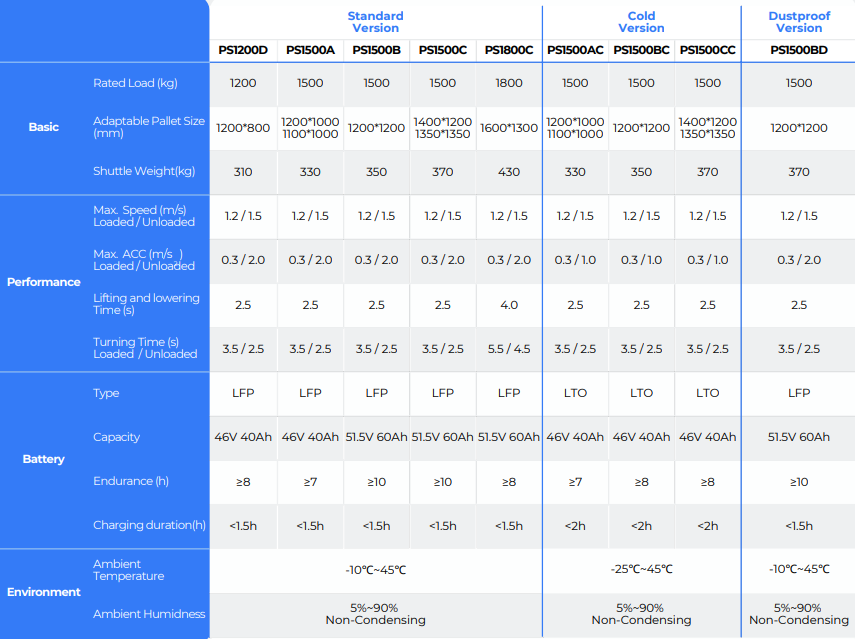
Managing multiple pallet types in one facility is made simple with the Atomixer Software Platform. Even if your warehouse utilizes differently sized Pallet Shuttles in separate zones, our software seamlessly integrates and controls your entire automated fleet. It manages routing, tracks inventory, and ensures that every storage and retrieval task is executed accurately.