
What Is the Bullwhip Effect and How to Reduce It in Supply Chains
In the complex web of modern supply chain management, a tiny ripple at the consumer level can easily transform into a massive, disruptive wave by the time it reaches the manufacturer. This phenomenon, where slight shifts in customer demand are progressively magnified as they move upstream, is known as the Bullwhip Effect.
In today’s highly dynamic e-commerce and retail environments, unpredictable demand is the new normal. Left unmanaged, the Bullwhip Effect leads to severe deviations in inventory management, bloated safety stocks, and delayed order fulfillment. Understanding this issue—and deploying the right smart automation technology to combat it—is crucial for building a resilient supply chain.
Effectively tackle the bullwhip effect with AtomixRobot’s integrated warehouse automation solutions.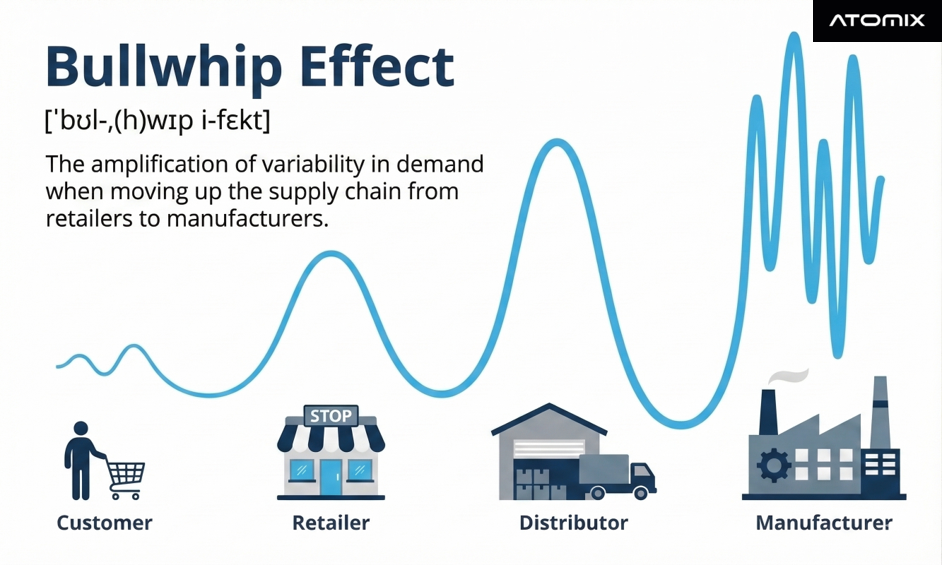
What Is the Bullwhip Effect and Why Does It Happen?
The Bullwhip Effect refers to the distortion of demand information as it travels from the end-consumer up to retailers, distributors, and manufacturers.
An Example of the Bullwhip Effect in Action
Imagine a retailer typically sells 10 units of a product daily. Suddenly, a weekend promotion bumps demand to 15 units. Fearing a stockout, the retailer orders 20 units from the distributor. The distributor, seeing orders double, assumes a permanent market shift and orders 40 from the manufacturer. The manufacturer then produces 80. A temporary 5-unit increase at the retail level resulted in a massive 70-unit overproduction upstream.
Key Causes of This Distortion:
- Lack of Supply Chain Visibility: When supply chain tiers operate in silos without sharing real-time Point-of-Sale (POS) data, everyone is forced to forecast based on immediate upstream orders rather than actual consumer behavior.
- Long Lead Times: The longer it takes to process, pick, and ship an order, the more safety stock companies feel compelled to hold, amplifying order sizes.
- Order Batching: Waiting to accumulate large orders to save on transportation creates artificial demand spikes.
- Inaccurate Inventory: Manual sorting and picking often lead to discrepancies between digital records and physical stock, causing unnecessary panic ordering.
Impacts of the Bullwhip Effect on Your Business
The consequences of the Bullwhip Effect directly threaten a company’s profitability and market responsiveness:
- Excess Inventory & High Holding Costs: Overestimating demand leads to bloated warehouses and tied-up working capital.
- Severe Stockouts: Conversely, misinterpreting a lull in demand can lead to stockouts when real demand returns, frustrating customers and damaging brand loyalty.
- Labor Inefficiencies: Sudden spikes in perceived demand force facilities into expensive overtime labor or chaotic, error-prone manual fulfillment rushes.
Strategies to Control the Bullwhip Effect
Before implementing advanced automation technologies, supply chain managers should adopt foundational strategies to control demand fluctuations. By addressing the root causes, businesses can create a more stable operational environment:
- Improve Information Sharing: Moving away from siloed operations is critical. Sharing Point-of-Sale (POS) data and inventory levels across the entire supply chain ensures that everyone from the retailer to the manufacturer is reacting to actual consumer demand, rather than distorted forecasts.
- Reduce Order Batching: Encourage smaller, more frequent orders rather than large, infrequent batches. This smooths out the demand curve and prevents artificial spikes in the system.
- Stabilize Prices: Implementing an “Everyday Low Pricing” (EDLP) strategy reduces the reliance on heavy discounts and promotions. This discourages “forward buying” and keeps consumer purchasing patterns steady.
- Limit Shortage Gaming: During product shortages, suppliers should allocate stock based on past sales records rather than current order sizes. This prevents retailers from artificially inflating their orders to secure more inventory.
How to Minimise the Bullwhip Effect with AtomixRobot
While completely eliminating demand fluctuations is impossible, businesses can drastically reduce the Bullwhip Effect by accelerating their response times and improving data accuracy. This is where AtomixRobot’s warehouse automation becomes a game-changer.
Here is how you can future-proof your supply chain against the Bullwhip Effect:
1. Shorten Lead Times with Autonomous Mobile Robots (AMRs)
The longer your order fulfillment takes, the more vulnerable your supply chain is to demand distortion. By implementing AtomixRobot’s AMR solutions (such as our advanced Goods-to-Person systems), warehouses can drastically cut down the time it takes to pick, sort, and pack orders. Shorter, more reliable lead times mean you can react to actual demand in real-time, eliminating the need to stockpile massive safety buffers “just in case.”
2. Build Agile Operations to Handle Demand Spikes
Traditional warehouses react to sudden demand spikes by throwing more manual labor at the problem—which is slow, expensive, and hard to scale. AtomixRobot allows you to build a highly flexible operation. During peak seasons or unexpected promotional spikes, you can easily adjust your AMR fleet’s workflows without overhauling your entire infrastructure. This agility prevents the panic-driven over-ordering that triggers the Bullwhip Effect.
3. Ensure 100% Inventory Accuracy and Visibility
You cannot combat the Bullwhip Effect with bad data. Manual warehousing processes are highly susceptible to picking errors and misplaced goods. AtomixRobot seamlessly integrates with your Warehouse Management System (WMS), providing real-time, 100% accurate visibility into your actual stock levels. When you and your supply chain partners know exactly what is in the warehouse at any given second, you can make procurement decisions based on facts, not distorted forecasts.
4. Optimize Sorting and Order Processing
Order batching creates artificial demand waves. AtomixRobot’s intelligent sorting robots enable continuous, highly efficient single-piece or multi-order picking. By streamlining the flow of goods, businesses can move away from clunky, large-batch ordering models and transition toward a smoother, leaner, and more continuous replenishment cycle.
Conclusion
The essence of the Bullwhip Effect lies in sluggish response times and isolated, inaccurate data. In a traditional, manual supply chain, everyone is guessing—and those guesses compound into costly errors.
By leveraging AtomixRobot’s cutting-edge warehouse automation and robotics, businesses can break free from this cycle. Upgrading to AMRs not only accelerates your fulfillment speed and guarantees inventory accuracy but also gives your supply chain the flexibility it needs to absorb market shocks smoothly.
Ready to stop the Bullwhip Effect from eating into your margins? Contact AtomixRobot today to discover how our intelligent automated solutions can optimize your warehouse and stabilize your supply chain.