What is Supply Chain Visibility?
In today’s interconnected global market, supply chains are more complex than ever. From sourcing raw materials across continents to delivering finished products to a customer’s doorstep, the journey of a product is fraught with potential blind spots. This is where supply chain visibility comes into play.
Supply chain visibility refers to a company’s ability to track and monitor every single component of its supply chain—from raw materials to final delivery—in near real-time. It is the transition from guessing where your products are to knowing exactly what is happening across your entire operational network.
Why is supply chain visibility important?
For decades, many businesses operated with fragmented views of their logistics. However, recent global disruptions have proven that this is no longer sustainable. Supply chain visibility is no longer just a “nice-to-have” feature; it is a fundamental requirement for business survival, risk management, and long-term profitability.
When you lack visibility, a simple delay in raw materials can unexpectedly halt your entire production line, leading to missed deadlines and frustrated customers. End-to-end transparency allows stakeholders to shift from reactive firefighting to proactive planning.
The role of ESG
Beyond operational efficiency, supply chain visibility is increasingly driven by strict Environmental, Social, and Governance (ESG) regulations. For most large companies, the majority of their environmental and social impact—such as carbon emissions or human rights risks like modern slavery—occurs deep within their supply chains.
With new legislations like the European Green Deal and various national due diligence laws, governments are demanding 100% transparency. Businesses must now be able to trace their materials back to the source to prove ethical practices and sustainable operations.
How does supply chain visibility work?
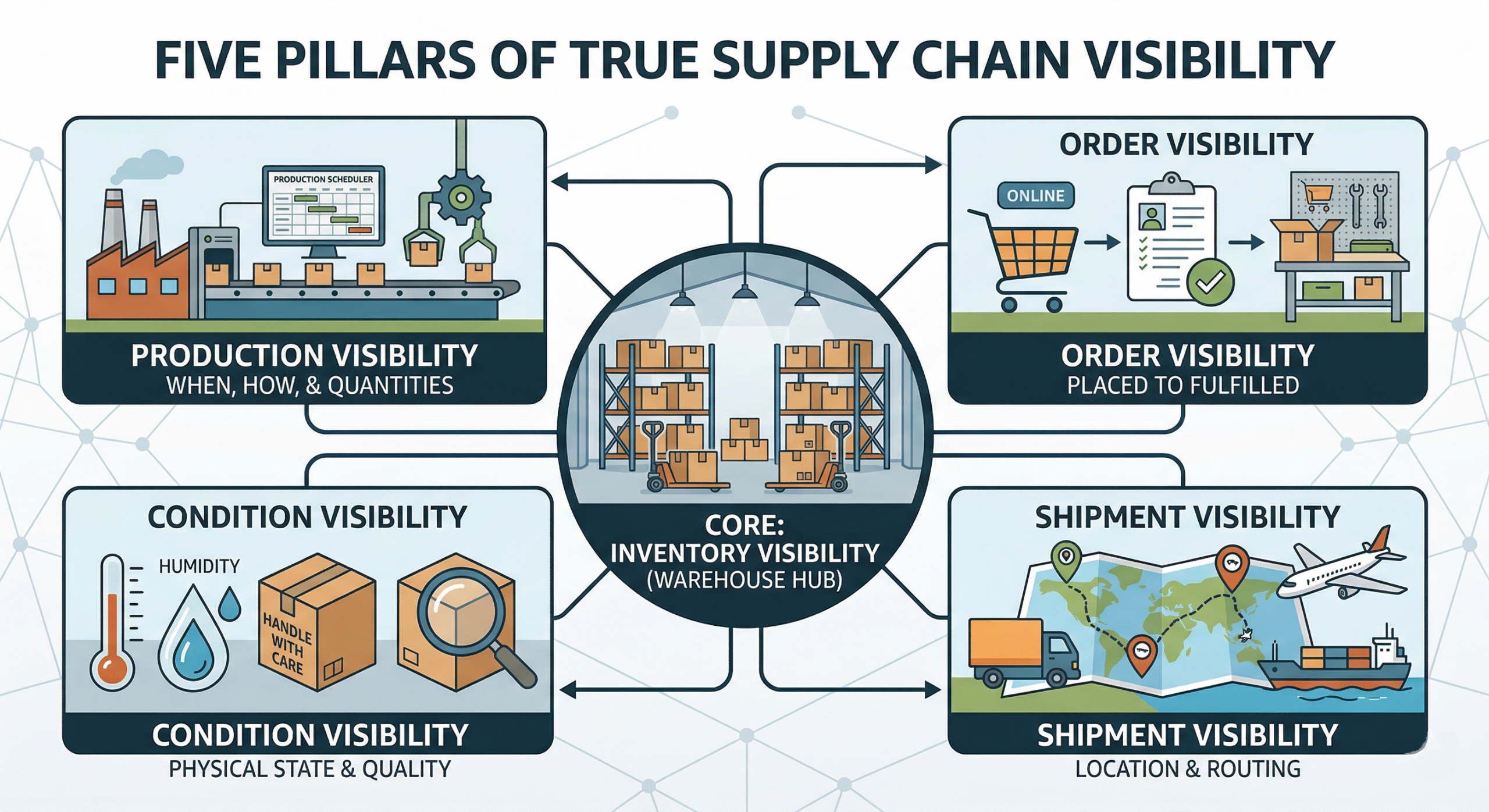
Achieving true visibility means connecting multiple moving parts into one comprehensive overview. It is not a single metric, but the combination of several tracking components:
- Order visibility: Tracking a sales order from the moment it is placed until it is fulfilled.
- Shipment visibility: Monitoring the exact location and routing status of goods as they move through complex transport networks.
- Condition visibility: Going beyond mere location, this involves tracking the physical state of the products—such as temperature, humidity, or potential transit damage—ensuring strict quality control.
- Production visibility: Understanding when, how, and in what quantities items are being manufactured.
Inventory visibility
At the very heart of this interconnected network lies inventory visibility. This means knowing exactly what stock you have, where it is physically located (down to the specific shelf or bin), and tracking its every movement within the warehouse. The warehouse is the core hub of data flow; if your inventory visibility is poor, the entire supply chain becomes paralyzed.
What are the benefits of supply chain visibility?
When a company successfully implements an end-to-end transparent supply chain, the business advantages extend far beyond the warehouse floor.
- Predictive Analytics and Forecasting: Advanced visibility does not just tell you what is happening now; it helps predict what might happen. By leveraging historical and real-time data, companies can forecast demand spikes or logistical bottlenecks before they occur.
- Improved Efficiency and Reduced Costs: By having a clear view of inventory and logistics, businesses can optimize transportation routes, reduce waste, and avoid the costly pitfalls of overstocking or stockouts.
- Enhanced Resilience and Risk Management: Visibility acts as an early warning system. It allows teams to identify supplier shortages or delays early, enabling them to implement backup plans before the bottom line is affected.
- Boosted Customer Satisfaction: Today’s customers demand transparency. Providing accurate, real-time updates on order statuses builds brand trust, fosters loyalty, and significantly reduces customer service complaints.
What are the challenges of supply chain visibility?
Despite the clear benefits, achieving total supply chain visibility is a struggle for many businesses. One of the biggest roadblocks is the reliance on manual data management. Many companies still use familiar spreadsheets like Excel to track inventory and suppliers. Manual updates are not only slow but highly prone to human error.
Furthermore, supply chains involve multiple third-party partners. Integrating all these external parties—each with their own software—onto a single, synchronized platform remains a significant hurdle.
What are data silos and data latency?
The ultimate enemies of visibility are “data silos” and “data latency.”
A data silo occurs when different systems within a company (like an ERP and a WMS) do not communicate with each other. When systems are disconnected, teams suffer from a lack of a “single source of truth,” leading to critical blind spots.
Even worse is data latency. Many warehouses operate on systems that update data in batches (e.g., end-of-shift reporting) rather than instantly. If your data is delayed by even a few hours, your “visibility” is merely an illusion of the past. To make agile decisions, businesses need absolute, second-by-second accuracy.
How to achieve supply chain visibility?
To overcome data silos and the lag of manual entry, companies must turn to smart automation and integrated software platforms. The key to achieving flawless supply chain visibility is ensuring that the physical movement of goods automatically and instantly translates into digital data.
This is exactly what Atomix Robotics delivers. By implementing flexible and scalable warehouse automation solutions, businesses can transform their fulfillment centers from black boxes into highly transparent, real-time data hubs.
The power of Atomixer software and AMRs
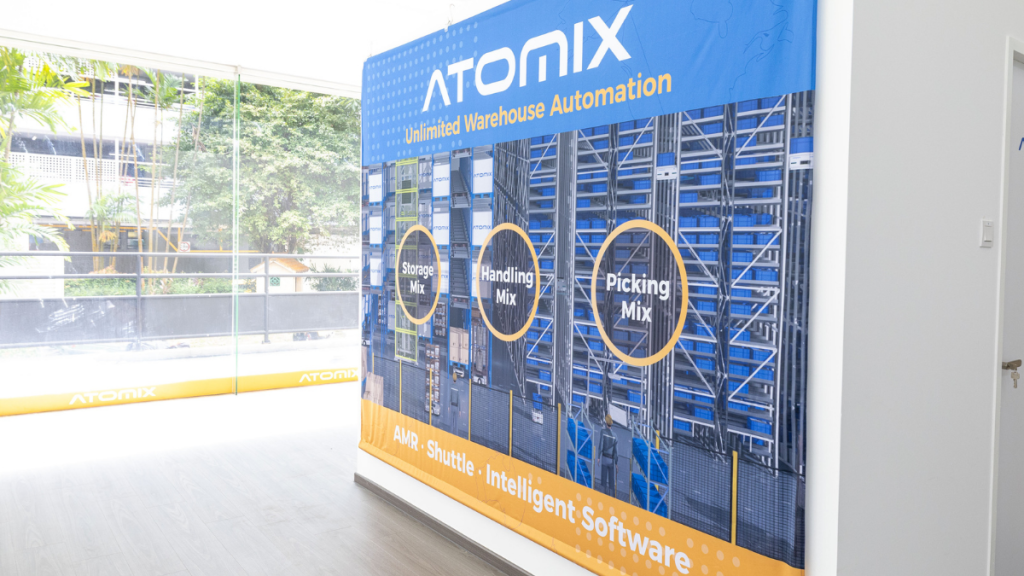
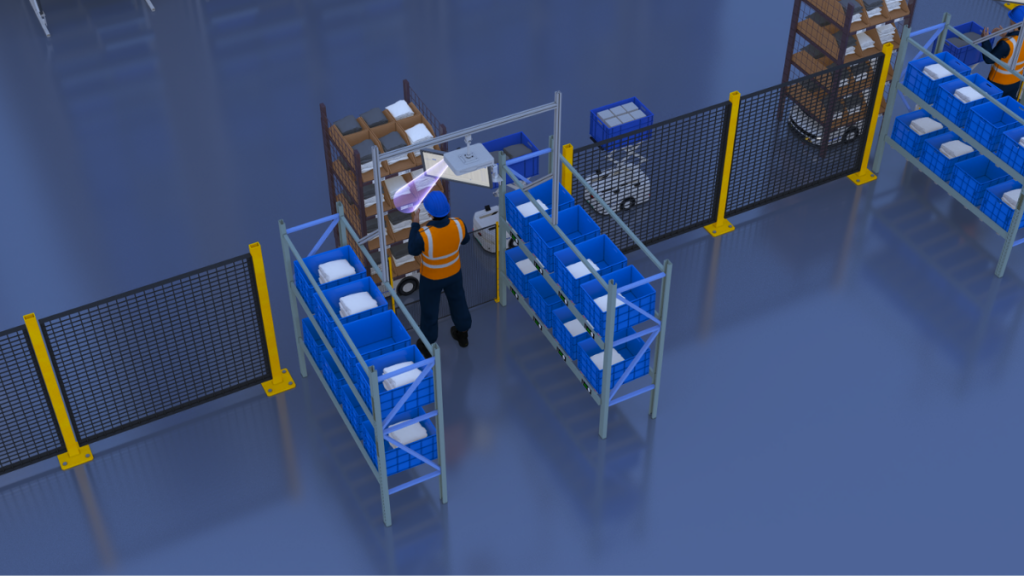
Atomix Robotics provides standard, mixed subsystems—Storage Mix, Handling Mix, and Picking Mix—that cater to diverse warehouse scenarios. At the core of this hardware is the Atomixer Software, a highly intelligent architecture integrated with over 50 advanced algorithms. It acts as the ultimate control tower for your warehouse.
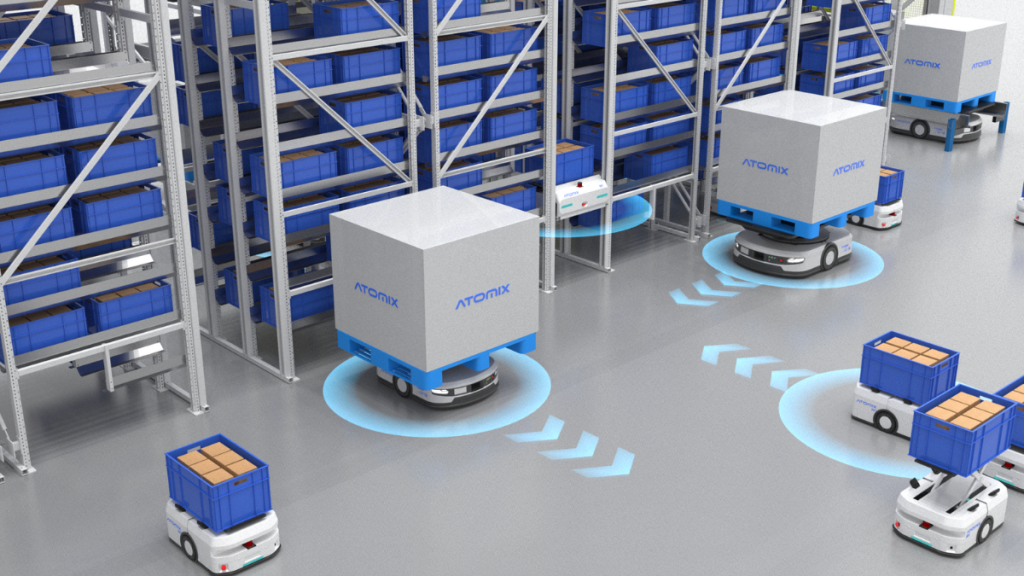
Instead of humans manually scanning barcodes and dealing with delayed batch updates, Atomix’s Autonomous Mobile Robots (AMRs) and Shuttles execute the physical tasks while simultaneously feeding precise, real-time data back to the central system. Whether it is a Pallet AMR moving heavy loads or a Bin Shuttle executing high-speed retrieval, every single action is tracked, recorded, and instantly visible.
By replacing guesswork with precision engineering and intelligent software, Atomix Robotics helps businesses break the boundaries of traditional warehousing.
Ready to future-proof your logistics and achieve total supply chain visibility? Contact Atomix Robotics today to explore our unlimited warehouse automation solutions.