How Automotive Parts Warehouses Handle Rapid SKU Growth: A Smart Automation Case Study
A typical passenger vehicle contains between 15,000 and 25,000 individual component parts. For the warehouse teams that store, pick, and ship those parts — whether to assembly plants, dealers, or aftermarket customers — managing that complexity has always been demanding. But a new wave of pressure is making the old approach unsustainable.
The rapid rise of electric vehicles is rewriting the parts landscape entirely. EVs introduce entirely new SKU categories — battery modules, power electronics, thermal management components — while existing ICE parts remain in circulation for millions of vehicles still on the road. According to Mordor Intelligence, the EV battery and power electronics logistics segment is already expanding at 11.6% CAGR — the fastest-growing category in automotive logistics.
At the same time, Penske Logistics notes that SKU proliferation creates compounding complexity: each new SKU brings increased pick path length, higher error risk, and tighter space constraints — without a proportional increase in warehouse footprint.
This case study examines how an automotive fastener manufacturer tackled that exact challenge — using a multi-technology automation system to dramatically increase storage density, pick accuracy, and throughput, without expanding its facility.
What you’ll learn in this case study:
|
The Growing Challenge in Automotive Parts Warehousing
The global automotive logistics market was valued at $286.8 billion in 2025 and is projected to reach $568.6 billion by 2035, according to GM Insights. That growth brings volume — but it also brings complexity that traditional warehouse models were never designed to absorb.
Industry research from TGW Logistics identifies four converging forces now reshaping parts warehousing:
| Pressure | What It Means in Practice |
| SKU Proliferation | New vehicle platforms, EV components, and aftermarket expansion add hundreds of new part numbers annually — each needing a dedicated storage location |
| Size Variability | Automotive fasteners alone range from sub-gram clips to structural bolts — requiring mixed-format storage that manual systems handle poorly |
| Demand Volatility | Production schedules change rapidly. Parts needed urgently at an assembly line can’t wait for slow manual picking cycles |
| Delivery Timelines | Just-in-time (JIT) delivery expectations leave no buffer for picking errors or mis-slots — a single wrong part can halt a production line |
These pressures compound over time. A warehouse that manages 1,000 SKUs with manual processes may function adequately. The same warehouse at 3,000 SKUs — without a change in approach — faces cascading inefficiencies: longer pick paths, more frequent location errors, slower throughput, and a workforce under sustained physical strain.
According to identEC Solutions, approximately 38% of automotive manufacturers already report logistical difficulty managing large volumes of spare parts distribution. That share will grow as EV-driven SKU complexity accelerates.
The Three Symptoms of an Overwhelmed Warehouse
Before reaching the automation decision, most automotive parts warehouses exhibit the same three failure patterns:
- Storage Capacity Exhaustion: Conventional racking reaches its vertical and horizontal limits. Space runs out before SKU growth does, forcing off-site storage with its associated transport costs and visibility gaps.
- Operational Throughput Decline: Manual picking in a dense, high-SKU environment is inherently slow. As SKU counts rise, average pick paths lengthen and throughput per person-hour falls — even as order volumes increase.
- System Fragmentation: Inventory managed across disconnected spreadsheets, WMS platforms, and physical paper tickets creates visibility gaps. Real-time inventory accuracy — essential for JIT fulfillment — becomes unachievable.
A Smart Warehouse Solution for Automotive Fasteners
Faced with a rapidly expanding product range and the operational limitations described above, a Fortune 500 automotive fastener manufacturer’s Shanghai facility initiated a warehouse transformation project. The objective was not incremental improvement — it was a fundamental re-architecture of how materials flow through the facility.
The project brief had three non-negotiable requirements: dramatically increase storage density within the existing building footprint, achieve 99.99%+ picking accuracy to protect downstream assembly quality, and enable 24/7 continuous operations without proportional increases in headcount.
The resulting solution — designed and deployed by Atomix — integrates five distinct automation technologies into a unified, AI-orchestrated workflow. Each layer addresses a specific operational constraint.
Key Technologies Behind the Automation System
1. Ultra-High-Density Storage: Four-Way Pallet Shuttle System
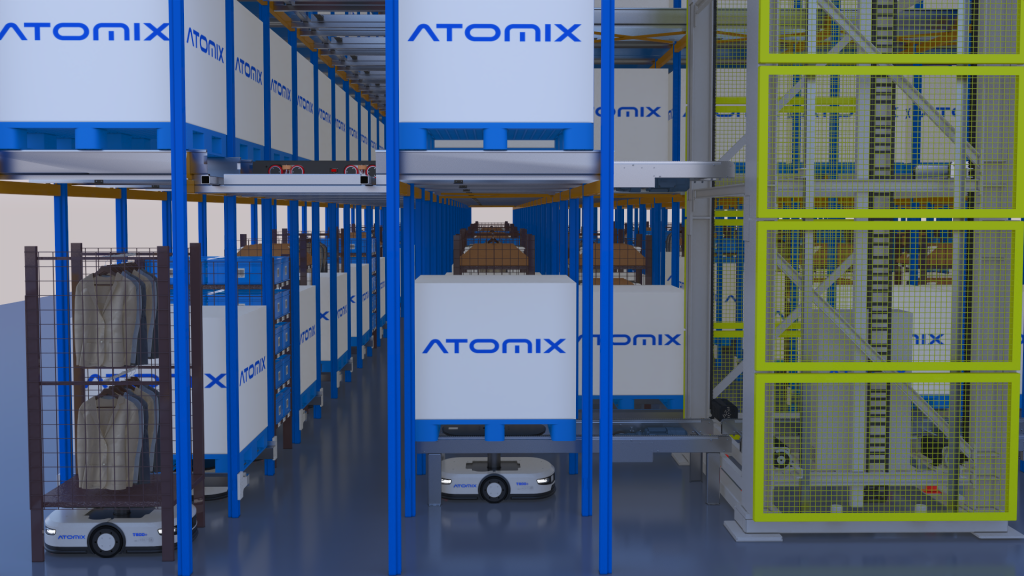
At the core of the storage layer is a four-way pallet shuttle system — an automated storage and retrieval solution in which battery-powered shuttle vehicles navigate a dense racking structure in multiple directions, retrieving and depositing pallets without human intervention.
Unlike conventional racking — where every pallet position requires aisle access and human reach — a four-way shuttle system collapses aisle space almost entirely. Pallets are stored in deep lanes, with the shuttle doing all the horizontal and vertical movement. The result in this deployment:
| Metric | Specification |
| Total SKUs Supported | 3,000+ |
| Pallet Locations | 12,000+ |
| Storage Density Improvement | 180% vs. conventional racking |
| Transport Method | AGVs + high-speed vertical lifts |
| Multi-directional Navigation | 4-way (X/Y axis + depth) |
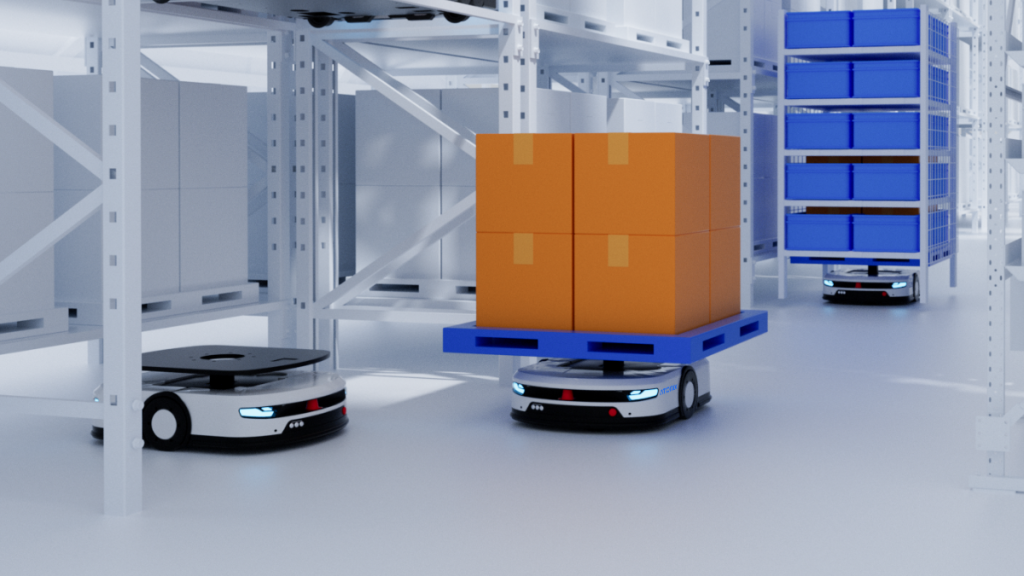
The shuttle units operate in conjunction with AGVs (Automated Guided Vehicles) for horizontal transport between storage zones and outbound staging areas, and high-speed vertical lifts to move pallets between storage levels without elevator queues.
2. Automated Case Picking: Three-Arm Robotic System
For individual carton picking — historically the most labor-intensive and error-prone activity in the facility — the solution deploys three robotic picking arms operating in coordinated sequence.
These robots handle depalletizing (breaking down inbound pallet loads into individual cartons) and carton picking (selecting specific SKUs for outbound orders). Each arm is equipped with vision-guided end effectors that identify and grasp cartons regardless of minor positional variation — a critical capability in a mixed-SKU environment where box sizes and weights differ significantly.
Achieved accuracy rate: 99.99%+, validated through integrated barcode verification at each pick point. Every carton is scanned before it advances in the workflow — mismatches trigger an automatic hold, not a downstream error.
3. Intelligent Order Sorting: Conveyor-Based Routing
Between picking and packing, a conveyor-based sortation system automatically routes cartons to one of 20 dedicated picking stations based on order assignments managed by the WES (Warehouse Execution System).
This eliminates the manual walk-to-station model that previously required workers to physically locate and transport cartons across the facility floor. The conveyor system creates a continuous, predictable material flow — with throughput measured in items per minute rather than per worker-hour.
4. Human–Machine Collaboration: Operator Integration
The system is not lights-out. Human operators remain central to several workflows — specifically final pallet assembly based on digital pick instructions displayed at workstations, exception handling when the system flags an anomaly, and ongoing operational monitoring via real-time dashboards.
This hybrid model deliberately preserves human judgment where it adds value — quality checks, unusual situations, system oversight — while removing humans from physically repetitive and high-error-risk tasks such as individual carton picking and pallet retrieval.
5. AI-Driven Scheduling and Peak Demand Optimization
The intelligence layer that orchestrates all physical systems is an AI scheduling engine that operates on two time horizons simultaneously:
- Real-time task allocation: Dynamic assignment of shuttle movements, AGV routes, and robot picking sequences to minimize idle time and eliminate bottlenecks as order patterns shift throughout the day
- Predictive pre-positioning: The system analyzes historical demand patterns and upcoming order data to identify fast-moving SKUs and relocate them closer to outbound staging areas before peak periods — reducing pick-to-ship time during high-demand windows
This predictive capability directly addresses one of the most cited challenges in automotive parts distribution: the inability to respond quickly enough to sudden demand spikes. According to Global Growth Insights, approximately 41% of automotive logistics companies experience warehouse capacity shortages during peak production periods. Pre-positioning eliminates much of that exposure.
Results: Measurable Improvements in Performance
The outcomes of the project were quantified against the baseline metrics established during the pre-automation operational assessment. The results across all three primary objectives were met or exceeded:
| +180%
Storage Density vs. conventional racking |
+35%
Operational Efficiency across all picking workflows |
99.99%+
Pick Accuracy barcode-validated at every step |
| 24/7
Operations Continuous automated operation |
Reduced
Labor Intensity and headcount per unit output |
The 180% storage density improvement is particularly significant. Achieving it without physical building expansion means the capital cost of the automation project is partially offset by avoided real estate costs — a factor that dramatically improves the project’s ROI calculation and shortens payback period.
The 35% operational efficiency gain reflects not just faster picking, but the elimination of non-value-adding movement: workers walking to retrieval locations, manually locating misslotted items, and correcting picking errors before shipment.
Why Four-Way Pallet Shuttle Systems Are Ideal for High-SKU Warehouses
The selection of a four-way pallet shuttle system as the primary storage technology was not arbitrary. In a high-SKU environment, the system’s specific capabilities address constraints that other storage technologies cannot resolve as effectively.
| Requirement | Four-Way Shuttle Advantage | Why It Matters for Automotive Parts |
| High SKU Count | Each lane can be dedicated to a specific SKU without aisle overhead | 3,000+ SKUs require individual addressable locations |
| Flexible Routing | Multi-directional movement accesses any location without repositioning | Parts needed urgently can be retrieved from deep storage in seconds |
| Scalability | Additional shuttle units integrate without structural changes | Business growth doesn’t require facility expansion |
| Mixed Load Types | Compatible with pallets of varying heights and weights | Automotive fasteners ship in many configurations |
| Space Efficiency | Near-elimination of aisle space vs. conventional racking | Critical when building expansion isn’t an option |
For context: conventional adjustable pallet racking achieves roughly 30–40% space utilization of a warehouse cube. A four-way shuttle system routinely achieves 70–85% cubic utilization — a difference that, at the scale of a 12,000-pallet-location facility, represents an enormous reduction in required footprint, energy consumption, and building cost.
A Scalable Automation Model for Future Growth
One of the most commercially important aspects of this deployment is its modular architecture. The system was designed explicitly to grow with the business — not to be replaced when the business outgrows it.
How the System Scales
- Additional shuttle units: New shuttle robots can be commissioned into existing rack structures without physical modification to the lanes or lifts
- Increased storage levels: Racking height can be extended vertically within building clearance constraints, with shuttles and lifts upgraded to serve additional tiers
- Additional automation modules: New robotic arms, conveyor extensions, or sorting stations can be integrated into the Atomix control layer via standard software interfaces — no system rebuild required
This modularity is directly relevant to the EV transition challenge described in the introduction. As EV-related SKUs expand a warehouse’s product range over the next 3–5 years, the system can absorb that growth incrementally — rather than requiring the organization to embark on another full-scale automation project.
According to Lean Supply Solutions, electric vehicle production demands new parts and battery management systems requiring specialized procedures that inbound logistics must adapt to. A modular automation platform provides exactly the adaptability that rigid, fixed-infrastructure systems cannot.
What This Means for Automotive Warehouse Operators
This case study is one data point in a broader industry-level shift. The evidence from market research, logistics operators, and technology deployments consistently points in the same direction: the manual warehouse model for high-SKU automotive parts is reaching structural limits that more headcount or better processes alone cannot solve.
The Business Case for Automation Is Stronger Than It Appears
The upfront investment in a system like this is significant. But the financial model includes multiple cost-reduction vectors that are easy to undercount:
- Avoided real estate costs: A 180% density improvement means the same inventory fits in roughly one-third of the floor space — deferring or eliminating costly facility expansions
- Labor efficiency gains: Automation doesn’t necessarily mean fewer jobs — but it means fewer labor hours per unit output, which directly improves cost per pick
- Error cost elimination: In automotive supply chains, a single mis-picked part that halts a production line can cost tens of thousands of dollars. At 99.99% accuracy, that risk is effectively eliminated
- Scalability without proportional cost: A modular system absorbs volume growth at marginal cost — unlike manual operations, which require proportional headcount additions
Industry data supports urgency: Global Growth Insights reports that 49% of automotive logistics providers have now deployed advanced warehouse automation systems. Organizations that delay the decision are increasingly competing against peers who have already captured the efficiency advantages.
Key Takeaways from This Case Study:
|
The Atomix Products Behind the ITW Project
The ITW warehouse deployment draws on two Atomix application platforms working in combination. Storage Mix — built around four-way pallet shuttles, Pallet AMRs, and Atomixer software — handled the ultra-high-density storage layer: 3,000+ SKUs across 12,000+ pallet locations, with 25% higher pallet density than conventional racking and 99% space utilization.
Picking Mix covered the order fulfillment layer: robotic depalletizing and carton picking via coordinated shuttle and AMR workflows, routed through the conveyor sortation system to 20 picking stations. Picking Mix supports up to 1,000 pallets/hour throughput and is designed to scale storage capacity and throughput independently — so the system grows with SKU count and order volume without a full infrastructure rebuild.
If either challenge — storage density or picking throughput — is a constraint in your operation, both product pages are worth a look.