Automated Material Handling: Systems, Technologies, Benefits and ROI
Global supply chains are under mounting pressure. Labor shortages, rising operational costs, and the surge in e-commerce order volumes have forced warehouses, manufacturers, and logistics operators to rethink how they move, store, and track materials. The answer, for a growing number of organizations, is automated material handling (AMH) — a suite of technologies that replaces or augments manual labor with robotics, intelligent software, and connected devices.
According to the Material Handling Industry of America (MHIA), the material handling and logistics technology industry generates over $262 billion in annual U.S. revenue, with automation as the fastest-growing segment. This guide covers everything decision-makers, engineers, and supply chain professionals need to know about AMH — from how systems work, to real-world examples, costs, ROI, and what the future holds.
Key topics covered in this guide:
|
What Is Automated Material Handling?
Automated material handling refers to the use of robotics, conveyor systems, automated vehicles, control software, and digital tracking technologies to move, store, protect, and control materials throughout a facility — whether that’s a manufacturing plant, distribution center, or e-commerce fulfillment hub.
Unlike traditional manual material handling — which relies on workers using hand trucks, forklifts, and manual sorting — AMH systems operate continuously, with greater speed, consistency, and precision. They don’t fatigue, they don’t make picking errors from distraction, and they can scale in response to demand fluctuations without proportional increases in headcount.
The International Federation of Robotics (IFR) reports that global installations of industrial robots reached a record 590,000 units in 2023, with warehousing and logistics emerging as the dominant growth sector — a direct reflection of AMH adoption accelerating worldwide.
| Manual Material Handling | Automated Material Handling |
| Labor-intensive, prone to fatigue | Operates 24/7 without fatigue |
| Higher error rates in picking/sorting | Sub-1% error rates with AI vision |
| Limited scalability during peak demand | Scales dynamically with demand |
| Higher long-term labor costs | Reduced labor costs after payback |
| Workplace injury risk is significant | Minimizes repetitive strain and accidents |
How Automated Material Handling Systems Work
An AMH system is not a single product — it is an integrated ecosystem of physical hardware, intelligent software, and real-time tracking technologies working in concert. Understanding each layer is essential for making informed purchasing and design decisions.
Hardware Components
The physical layer of an AMH system consists of the machines and devices that move and store goods:
- Conveyors: Belt, roller, and overhead conveyors form the backbone of continuous material transport in warehouses and production lines. High-throughput systems can move thousands of items per hour.
- Robotic Arms: 6-axis articulated robots handle picking, packing, welding, and palletizing. Modern collaborative robots (cobots) work safely alongside human workers.
- Automated Guided Vehicles (AGVs): Fixed-path vehicles guided by magnetic strips, QR codes, or laser reflectors. Reliable for repetitive transport routes in stable environments.
- Autonomous Mobile Robots (AMRs): Unlike AGVs, AMRs use onboard sensors and AI to navigate dynamically, recalculating routes in real time to avoid obstacles.
- Automated Forklifts: Self-driving forklifts handle pallet movement and high-bay storage without a human operator.
- Automated Storage and Retrieval Systems (AS/RS): High-density racking systems with automated cranes or shuttles that store and retrieve products at high speed. Ideal for operations with thousands of SKUs.
Software Systems
Hardware without software is just machinery. The intelligence layer of AMH includes:
- Warehouse Management Systems (WMS): Manage inventory locations, order fulfillment workflows, and labor allocation. WMS platforms such as Manhattan Associates, Blue Yonder, and SAP EWM are commonly deployed.
- Warehouse Execution Systems (WES): Bridge the gap between WMS strategy and physical execution — directing robots, conveyors, and workers in real time to optimize throughput.
- Manufacturing Execution Systems (MES): In production environments, MES platforms coordinate material flow between machines, track work-in-progress, and feed quality data to ERP systems.
Tracking Technologies
To ensure materials move accurately through the facility, AMH systems rely on several tracking methods:
- Barcode Scanning: The most widely deployed technology. Fixed scanners and handheld devices read 1D/2D barcodes at rates exceeding 600 scans per minute in conveyor tunnels.
- RFID (Radio Frequency Identification): Tags can be read without line-of-sight and can identify multiple items simultaneously. According to GS1, RFID can reduce inventory inaccuracies from 65% to under 5%.
- Sensors and IoT Devices: Weight sensors, proximity sensors, and temperature monitors feed real-time operational data into WMS dashboards.
- AI Vision Systems: Camera arrays paired with machine learning models identify items by shape, label, or defect status — enabling quality control and automated sorting without barcode dependency.
Types of Automated Material Handling Systems
Different operations have different needs. The following system types represent the core categories buyers evaluate when designing an AMH solution.
1. Conveyor Systems
Conveyors are the workhorses of warehouse and manufacturing automation. They provide continuous, high-volume transport of products between workstations, sorting systems, packing areas, and shipping docks. Modern sortation conveyors — such as cross-belt and tilt-tray sorters — can handle 20,000+ items per hour with better than 99.9% sort accuracy.
Best for: High-volume distribution centers, e-commerce fulfillment, postal and parcel operations.
2. Automated Guided Vehicles (AGV)
AGVs follow pre-defined paths — typically laid out via magnetic tape, embedded wires, or laser targets — to transport pallets, carts, or bins between fixed points. They are highly reliable in controlled environments and well-suited for repetitive, predictable transport tasks.
Best for: Manufacturing plants with defined material flow lanes, cold storage facilities, automotive assembly lines.
3. Autonomous Mobile Robots (AMR)
AMRs represent the next evolution beyond AGVs. Equipped with LiDAR, cameras, and onboard AI, they build dynamic maps of their environment and navigate freely — rerouting around obstacles, adapting to layout changes, and collaborating in fleets. Vendors such as Locus Robotics and Mobile Industrial Robots (MiR) offer AMR platforms purpose-built for fulfillment and manufacturing environments.
Best for: E-commerce picking, hospital logistics, dynamic environments where layouts change frequently.
4. Robotic Picking and Palletizing
Robotic picking systems use vision-guided arms to identify, grasp, and place individual items — a task that has historically required human dexterity. Advances in gripper technology (suction, magnetic, soft-touch) and AI vision have dramatically expanded the range of products that robots can reliably handle. Palletizing robots build stable pallet loads at speeds far exceeding manual teams.
Best for: E-commerce item picking, food and beverage packing lines, end-of-line palletizing in manufacturing.
5. Automated Storage and Retrieval Systems (AS/RS)
AS/RS systems maximize vertical storage density by using automated cranes, shuttle cars, or robotic cubes (such as Ocado’s Hive grid) to store and retrieve products from high-density racking. A single AS/RS installation can store the same inventory that would require a warehouse 3–4 times larger in a conventional setup.
Best for: Pharmaceutical cold-chain, automotive spare parts, high-SKU retail distribution.
Examples of Automated Material Handling in Practice
Abstract descriptions of technology only go so far. The following real-world examples illustrate how AMH systems operate across different sectors.
Warehouse Automation: Amazon Fulfillment Centers
Amazon’s fulfillment network is perhaps the world’s most visible example of AMH at scale. The company operates over 750,000 robots globally (as reported by Reuters), combining Kiva drive units (now Amazon Robotics), robotic sorting arms, conveyor systems, and AI-driven inventory management. The result: order-to-ship times measured in hours rather than days, with picking accuracy approaching 99.9%.
Manufacturing: Toyota Production System
Toyota’s lean manufacturing philosophy has long embraced automated material flow. Their plants use AGV-based ‘just-in-time’ (JIT) delivery to deliver components to assembly stations precisely when needed — eliminating buffer inventory and reducing material handling labor. This model, documented by the Toyota Global Newsroom, has been adopted by automotive manufacturers worldwide.
E-commerce Fulfillment: Zalando and Ocado
European e-commerce leaders have invested heavily in robotic fulfillment. Ocado’s Customer Fulfilment Centres (CFCs) use a grid-based robotic system where hundreds of bots retrieve grocery totes simultaneously — processing up to 65,000 orders per week from a single facility with a headcount that would be impossible in a conventional warehouse.
Semiconductor AMHS: TSMC and Intel Fabs
Semiconductor manufacturing demands the most precise AMH environments on earth. Cleanroom automated material handling systems (AMHS) — such as Overhead Hoist Transport (OHT) systems — transport wafer carriers between processing stations without human contact, preventing contamination. According to SEMI, leading fabs process wafers through 600–1,000 process steps, all coordinated by automated transport systems operating continuously.
Benefits of Automated Material Handling
Organizations that implement AMH systems report benefits across operational, financial, and human dimensions. Here is a structured breakdown:
| Benefit | What It Means | Typical Impact |
| Operational Efficiency | Systems run 24/7 without breaks or shift changes | 2–3× throughput increase |
| Reduced Labor Costs | Fewer manual handlers needed for routine tasks | 20–40% labor cost reduction |
| Workplace Safety | Removes humans from heavy lifting and hazardous zones | Up to 70% fewer handling injuries |
| Higher Accuracy | AI vision and barcodes eliminate mispicks | 99%+ order accuracy |
| Space Utilization | AS/RS and vertical storage maximize floor density | Up to 85% space reduction |
| Scalability | AMRs and modular conveyors scale with demand | Flex capacity without hiring surges |
The Occupational Safety and Health Administration (OSHA) estimates that musculoskeletal disorders from manual material handling cost U.S. employers over $20 billion annually in workers’ compensation — a cost largely eliminated through automation.
Industries Using Automated Material Handling
Warehousing and Logistics
Third-party logistics (3PL) providers and distribution centers were among the earliest large-scale AMH adopters. Automated sortation, conveyor systems, and AS/RS are now standard infrastructure for high-volume distribution — particularly in parcel, retail replenishment, and cold-chain logistics.
E-commerce
The explosion of direct-to-consumer fulfillment has made AMH adoption a competitive necessity in e-commerce. Processing thousands of single-item orders per day with tight SLA windows requires robotic picking, automated packing, and intelligent sortation that no manual operation can match at scale.
Manufacturing
From automotive assembly to electronics production, manufacturers use AMH to deliver components to the line on demand, transport work-in-progress between stations, and manage finished goods without manual intervention — aligning material flow with production schedules in real time.
Semiconductor Industry
Chip fabs operate the most sophisticated AMH environments in existence. Wafer transport must be contamination-free, vibration-minimized, and precisely timed across hundreds of process steps. AMH is not optional in this sector — it is physically mandated by cleanroom requirements.
Food and Pharmaceutical Production
Hygienic design requirements, cold-chain mandates, and strict traceability regulations make automation critical in food and pharma. Automated packing lines, robotic depalletizing, and vision-based quality inspection reduce contamination risk and support regulatory compliance with full audit trails.
How to Implement Automated Material Handling Systems
Successful AMH implementation is a structured process that spans assessment, design, integration, and ongoing optimization. Rushing any phase is one of the most common causes of project failure.
Step 1: Evaluate Your Current Operations
Before specifying any technology, conduct a thorough operational analysis. Map your existing material flows, identify throughput bottlenecks, measure error rates, and quantify current labor costs. Time-motion studies and facility layout analysis provide the baseline data that justifies — or refines — the automation business case.
Step 2: Define Automation Goals
Automation initiatives fail when objectives are vague. Define specific, measurable targets across three dimensions:
- Throughput: Target units per hour, orders per day, or shifts per week
- Cost Reduction: Labor cost savings, error-related cost elimination, or inventory carrying cost reduction
- Safety: Target reduction in manual lifts, injury frequency rate improvement, or ergonomic compliance goals
Step 3: Design the Automation System
System design must account for three variables simultaneously:
- Facility Layout: Column spacing, floor load capacity, ceiling height, and dock positions constrain equipment choices
- Volume and Mix: Peak daily throughput, SKU count, and order profile (single-item vs. multi-line) determine system sizing
- Scalability: Design for Day 1 requirements while preserving headroom for 3–5 year volume growth
Step 4: Integrate with Existing Systems
AMH systems generate value only when connected to the broader technology stack. Integration with WMS, MES, and ERP platforms ensures that automated equipment receives accurate task orders and returns real-time inventory and production data. Middleware platforms such as SAP, Oracle, and Microsoft Dynamics provide standard connectors for most major AMH vendors.
Step 5: Train Employees
Automation changes roles — it rarely eliminates them entirely. Workers transition from manual transport to system monitoring, exception handling, and maintenance. Structured training programs covering HMI operation, safety protocols, and first-line troubleshooting are essential for maximizing uptime and employee confidence.
Step 6: Plan Maintenance and Expansion
Establish preventive maintenance schedules from Day 1. Build spare parts inventory for high-wear components. Define KPIs for system availability (target: 98%+) and throughput. Design expansion pathways — modular systems allow capacity additions without system shutdowns.
Cost of Automated Material Handling Systems
Investment levels vary enormously depending on system scope, facility size, and integration complexity. The table below provides representative ranges:
| Tier | Typical Investment | What’s Included |
| Entry-Level | $50,000 – $500,000 | Basic conveyors, standalone barcode systems, simple robotic arms for single tasks |
| Mid-Level | $500,000 – $5 million | AGV fleets, AS/RS for core SKUs, WMS integration, semi-automated packing lines |
| Advanced | $5M – $50M+ | Full AMR fleets, robotic picking, AI vision, end-to-end WES, facility redesign |
Additional Cost Categories to Budget For:
- Installation and commissioning: Typically 15–25% of equipment cost
- System integration (WMS/ERP): $50,000–$500,000+ depending on complexity
- Employee training: $10,000–$100,000 for initial and ongoing programs
- Annual maintenance contracts: 5–10% of equipment value per year
ROI of Automated Material Handling
Typical Payback Period
Industry benchmarks from MHI (Material Handling Industry) and independent consultancies consistently show payback periods of 2–5 years for well-scoped AMH projects. Highly labor-intensive operations with three-shift patterns tend to reach payback fastest — often within 24–30 months.
ROI Drivers
| ROI Driver | How It Saves Money | Magnitude |
| Labor Savings | Fewer direct handling FTEs required | Often the single largest ROI driver |
| Throughput Improvement | More orders processed per shift | 2–4× capacity from same footprint |
| Error Reduction | Fewer returns, re-picks, and credits | $5–$25 cost savings per avoided error |
| Damage Reduction | Consistent handling prevents product damage | 0.5–2% of revenue recovered |
| Space Optimization | Higher density storage = deferred real estate costs | Can defer or avoid facility expansions |
Automation ROI Calculator
Use the following formulas to estimate your automation ROI before engaging vendors. These calculations provide a foundation for building a business case:
| ROI Formula
ROI (%) = (Annual Net Benefit ÷ Total Investment Cost) × 100 Payback Period Formula Payback Period (years) = Total Investment ÷ Annual Net Savings |
Example Calculation:
| Input | Value |
| Total Investment | $2,000,000 |
| Annual Labor Savings | $600,000 |
| Annual Throughput Gains | $250,000 |
| Annual Error Reduction Savings | $80,000 |
2.2 years of 10
Explore Atomix Handling Mix →
Challenges of Automated Material Handling
AMH delivers significant advantages, but implementations that fail to account for the following challenges often underperform or stall:
System Integration Complexity
Connecting automated equipment to legacy WMS, ERP, and MES systems is consistently cited as the most common source of project delays and cost overruns. The solution: specify open-architecture systems with documented APIs, and engage integration specialists early — before equipment is ordered, not after.
Workforce Transition
Employee resistance to automation is real and understandable. Organizations that communicate transparently about role changes, provide genuine upskilling opportunities, and involve frontline workers in system design consistently achieve faster adoption and lower turnover during the transition.
Cybersecurity and Data Protection
Connected AMH systems are part of the operational technology (OT) network — and increasingly targeted by cyberattacks. The CISA (Cybersecurity and Infrastructure Security Agency) recommends network segmentation between IT and OT systems, regular penetration testing, and role-based access controls as baseline protections for automated industrial environments.
Future Trends in Automated Material Handling
The AMH landscape is evolving rapidly. The following trends are shaping what systems will look like — and what they’ll be capable of — over the next 3–7 years:
AI-Powered Warehouse Automation
Machine learning models are moving beyond vision and into orchestration — dynamically optimizing pick sequences, predicting demand spikes, rerouting material flow in real time, and scheduling maintenance before failures occur. AI is transforming the WES from a task dispatcher into an intelligent operations brain.
Next-Generation Autonomous Robots
The next wave of AMRs combines manipulation with mobility — robots that can not only navigate freely but pick items, open containers, and handle unstructured products without pre-programmed instructions. Companies such as Figure AI, 1X Technologies, and Apptronik are developing humanoid platforms targeting logistics environments.
Digital Twin Warehouses
Digital twins — virtual replicas of physical facilities — allow operators to simulate layout changes, model throughput scenarios, and test new automation configurations before spending a single dollar on hardware. Platforms like NVIDIA Omniverse are bringing photorealistic digital twin capabilities to warehouse and factory design.
Lights-Out Warehouses
The theoretical endpoint of AMH is a fully automated facility that operates without human workers present — no lighting required, no HVAC for human comfort. Several operations have achieved this in narrow contexts (e.g., automated freezer storage). Broader lights-out operation will become more feasible as robot dexterity and AI decision-making mature.
Smart Logistics Networks
AMH is evolving beyond individual facilities into connected supply chain networks — where inventory visibility, demand signals, and material flow orchestration span multiple sites and carrier networks in real time. This is the emerging frontier of supply chain automation.
Conclusion
Automated material handling is no longer a competitive advantage reserved for large enterprises — it is becoming baseline infrastructure for any operation competing on speed, accuracy, and cost efficiency. Whether you are a regional distributor evaluating your first conveyor system, or a global manufacturer planning a next-generation smart factory, the principles are the same: start with operational data, define clear goals, choose scalable technology, and integrate deeply.
The organizations that move deliberately and strategically on AMH today will be the ones with the operational resilience and cost structure to compete effectively in the decade ahead.
Key Takeaways:
|
Ready to Automate Your Material Handling Operations?
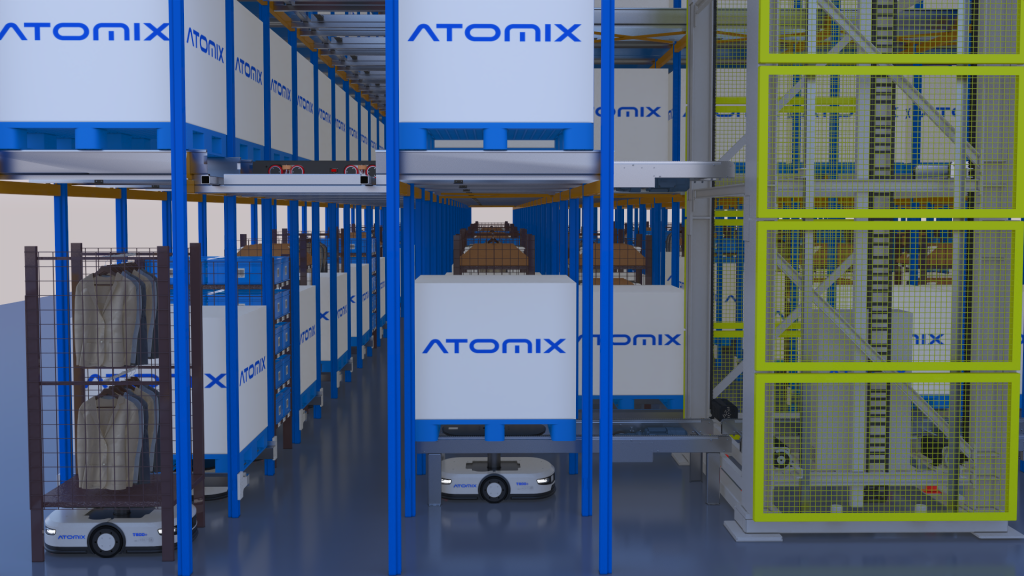
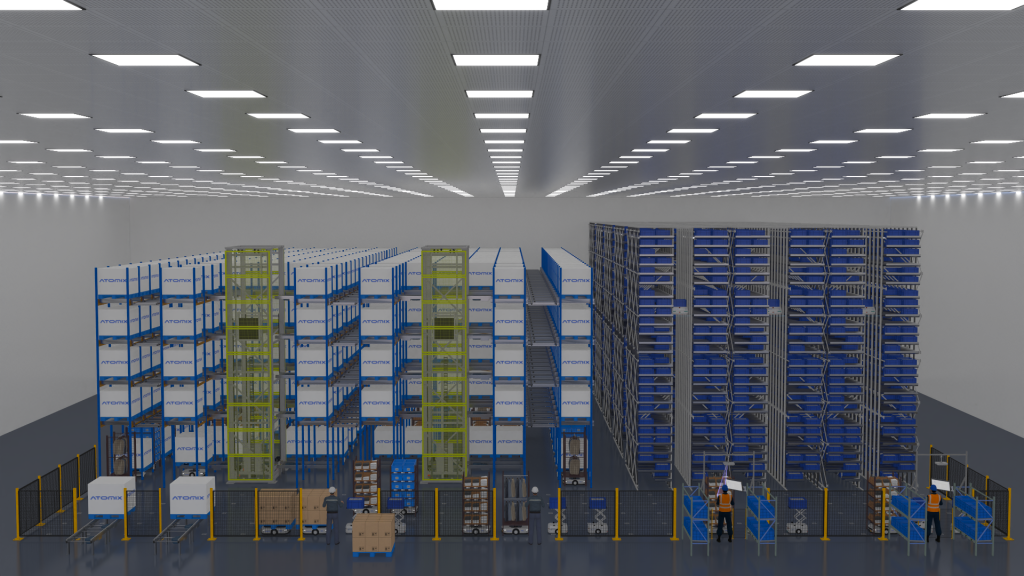
Choosing the right automation partner matters as much as choosing the right technology. Atomix specializes in full-container automated handling solutions — combining Pallet AMRs, Bin AMRs, and the proprietary Atomixer software platform to deliver flexible, high-throughput material handling across warehouse and factory environments.
| 🤖
Mixed Robots Pallet AMR + Bin AMR, compatible with 3rd-party robots |
📦
Mixed Containers Pallets, shelves, cages and bins — loads up to 1,500 kg |
🏭
Mixed Scenarios Inbound, outbound, intra-factory, GTP, and production line |
⚡
High Throughput Speed up to 4 m/s, powered by self-developed controller |
| Trusted by leading logistics operators across Asia, Europe, and South America
Lotte Global Logistics · JK Robotics · StudioLog Brazil · and hundreds more |